GettaJob.ai
Built for the worst week of your career. Résumés that never make anything up.
Most job tools assume the hard part is the formatting. The hard part is getting laid off, or being stuck somewhere you can’t stand, and still having to make your case to a stranger. This one is built for that week.
Problem
Someone close to me got laid off. They needed a résumé tailored to every posting and a way to keep the search straight, in the worst week of their year. Most of the tools wanted a monthly subscription and a good attitude.
My role
I set the product rules, designed the screens, wrote the copy, built it, and ran the paid evaluations that decided which models it uses and how many questions it asks.
Scope
Résumé tailoring with receipts, a Library of your work, a job-search funnel, and three modes for how the search actually feels: Funemployed, GTFO, and Discreet.
What changed
I rebuilt it from scratch. Version one rewrote the résumé you already had. Version two asks about the work you did, and won’t write a line it can’t trace back to you.
What this demonstrates
I design for the state a person is actually in, and I back product calls with evidence: capped, paid evaluations and blind reviews, not vibes.
Nobody job hunts on a good day.
I built the first version of GettaJob in 2023. Paste a job, paste your résumé, get a better résumé. It worked, and I set it down.
I came back to it in 2026 when someone close to me got laid off. Helping them search, the résumé turned out to be the smaller problem. The bigger one was doing all of it while angry and tired, and keeping track of which résumé went where.
So GettaJob does two jobs. It makes your case without making anything up, and it knows what kind of week you’re having.
Résumés are an evidence problem. Job hunting is a funnel problem. Neither one happens on a good day.
It invents experience
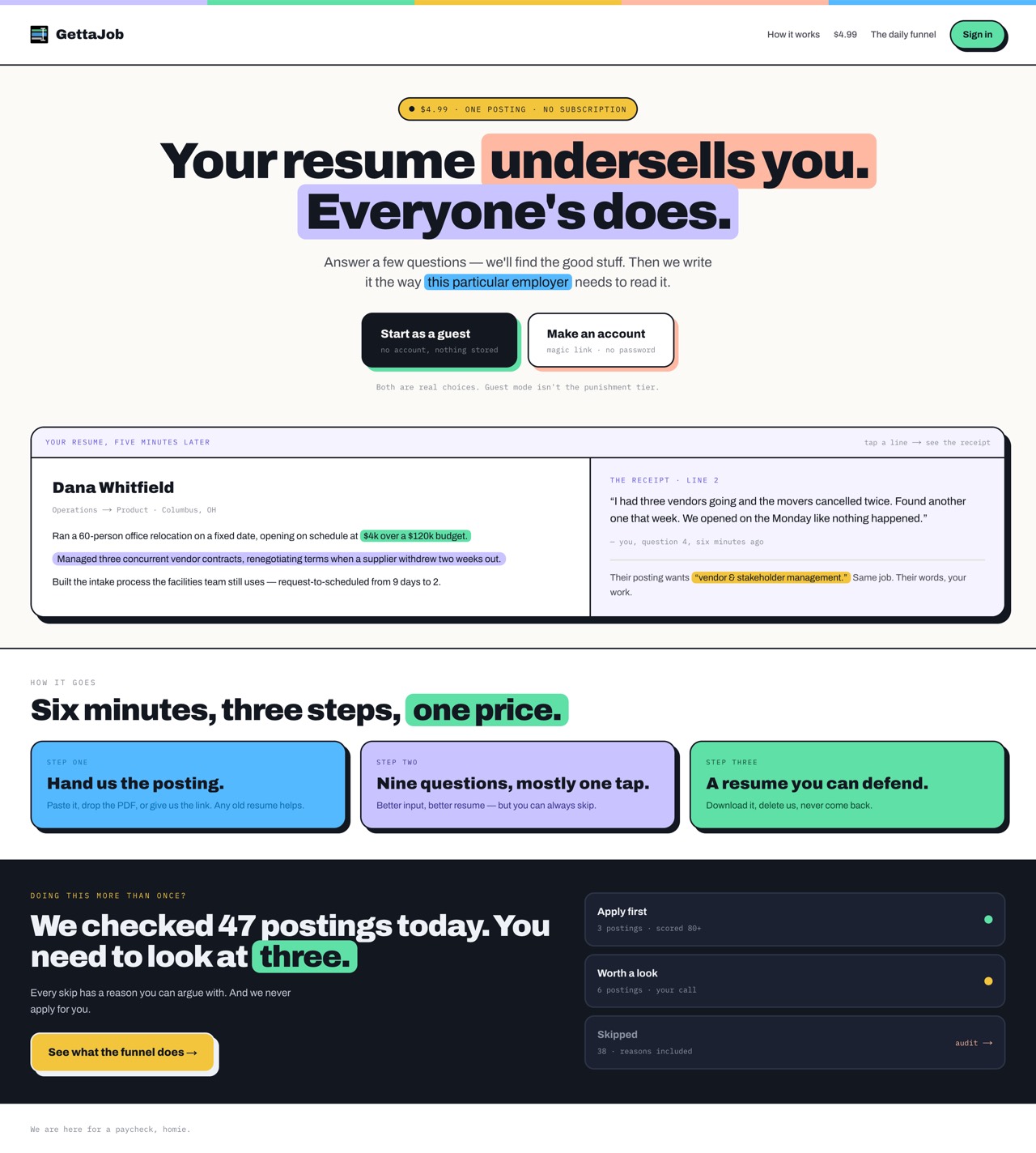
AI résumé tools will happily turn “helped with” into “led.” Here every line has to trace back to your old résumé or an answer you gave, and you can tap it to see which. Ownership verbs can’t be upgraded, and a limit you stated stays stated. If a true bullet comes out weak, it falls back to your original wording instead of a stronger lie.
The trade: some résumés come back plainer. Every line on them survives the interview.
It doesn’t know what you did
Most people can’t tell which of their own experiences matter for a given job. So it lines your résumé up against the posting, shows what’s matched, partial, and missing in the posting’s own words, then asks up to six questions and up to four more. Every one is skippable. A strong résumé usually gets none.
You start over every time
Your roles, wins, and wordings live in a Library. Every signed-in tailoring reads from it, and every approved résumé feeds back into it, so the next application starts where the last one ended.
You forget which résumé you sent
Follow companies and their new roles show up on Today as plain facts, with no made-up match score unless you ask for a fit assessment. When you apply, it freezes the job description and the exact résumé you sent, so the recruiter call doesn’t start with you guessing.
It assumes you’re fine
Funemployed mode is for after a layoff: five heat levels from Peace to BIG MAD, the admin nobody warns you about with a COBRA countdown, dated public news about the company that let you go, and a crisis line at every level. GTFO mode is for people who still have the job and want out. Discreet mode turns the whole app into a spreadsheet, a slide deck, or a document with one shortcut, so you can job hunt from the desk you’re trying to leave.
Every model and every question had to earn its place.
Each evaluation ran on real product code, with a spending cap I set before it started. Before drafting went live, I ran six models against 126 synthetic résumé cases. Then I tested a lighter question policy: two rounds, one question per topic, and code that drops any question that can’t name the bullet it would change.
With simulated people answering, fewer questions kept the useful facts when the answers were brief, 23 before and 24 after, and lost a few when they rambled, 22 to 18. No test run invented a number or lost a fact it was given. When a cheaper second-round model looked as good on paper, I blind-reviewed ten pairs myself before switching. It tied, 4 to 4, so I approved it. It saves about 12% on a real run.
4.89 / 5
Opus 5.5’s drafting score across the six-model matrix, 20 of 21 cases acceptable, at about 3.6¢ a case. It got the job.
56 → 21
Questions asked across the test runs after the lighter policy, with the useful facts in the final résumé holding for brief answers.
$2.94 → $1.54
The cost of a real tailoring run before and after. The person it was built for said the new résumé was much better.
Packs that never expire. Never a subscription.
Organizing a search is free: browse companies, follow them, track applications, keep your résumé history. No AI runs on the free plan. You pay only when you ask the AI to do something, and what you buy doesn’t expire.
I priced it assuming people use everything they pay for. Nothing here depends on someone forgetting to cancel. The free plan is open now and the paid packs are next.
$2.99
10 fit assessments. $11.99 for 50.
$4.99
One application prep: the fit assessment, the questions, a tailored résumé, and two AI update rounds. $13.99 for three.
$15.99
10 assessments and 3 preps. $24.99 for 15 and 5. Every paid pack includes GTFO and Funemployed mode.
Teal, Jobscan, Rezi, Huntr, and Kickresume mostly sell monthly plans, from about $24 to $50 a month. A job search doesn’t end on a billing date.
GettaJob sells small packs that never expire and keeps the organizing free. The goal is written into the pricing page: get a job, lose the need for us.
Early. The free plan is open and a few people use it, including the person I built it for. The paid packs are built and waiting on launch.
The Library loop is new and hasn’t proven itself across many real searches yet. Fit scores aren’t calibrated, so the app says so instead of passing them off as interview odds.
Next is showing every question an application will ask, with answers ready from your Library. It still won’t apply for you. Filling in the answer that passes, for someone who can’t honestly give it, is coaching them to lie.
Make your case. Keep the receipts.
One project on the registry. Need the same thinking pointed at your product? Bring me into the work.